Model of the Week
Claude Opus 5 cracks FreeCAD and builds its own tools
Anthropic shipped Opus 5. It solves tasks other models give up on, and hallucinates 14 points more often than its predecessor.
 Thomas Reigl Updated 5 min read

Anthropic handed the new model a technical drawing of a machine part inside FreeCAD, a CAD application. It could not read the image, because it had no ability to.
So it wrote itself one. The model built its own computer vision pipeline to read the geometry out of the raw pixels, then reconstructed the part. Other models gave up on the same task after five attempts.
That is the leap, and it appears in no benchmark table: when this model lacks a tool, it does not stop, it builds one.
What did not work before
Models rarely fail at a single step. They fail in the gap between steps: a format does not match, an export is missing three columns, and what comes back is a polite paragraph instead of a result.
Translated to an actual business process, the kind of work any of these models gets pointed at: the order arrives as a PDF, the line items need to go into the ERP, and one of them is not in the article list. The last generation reports back here. This one finds a way around. Useful, as long as somebody checks which way it took.
The numbers
| Benchmark | What it measures | Opus 5 | Comparison |
|---|---|---|---|
| Frontier-Bench v0.1 | multi-step terminal work, from bug to finished feature | 43.3% | Opus 4.8: 18.7%, Fable 5: 33.7%, GPT-5.6 Sol: 37.5% |
| ARC-AGI 3 | task types with no instructions and no stated goal | 30.2% | Opus 4.8: 1.5%, GPT-5.6 Sol: 7.8% |
| Intelligence Index (Artificial Analysis) | nine evaluations combined | 61, rank 1 of 184 | Fable 5: 60, Kimi K3: 57, Opus 4.8: 56 |
| Capabilities Index (Epoch AI) | same goal, different method | 159 | Fable 5: 161 |
| Cost per task | what one completed job costs | $2.03 | Fable 5: $2.75, Opus 4.8: $1.80 |
Claude Fable 5, for the record, is not a competing product but Anthropic’s own flagship, priced at twice as much, $10 and $50 per million tokens. When Opus 5 beats its best result, no challenger is winning anything. A vendor is rearranging its own shelf.
And the two independent evaluators disagree: Artificial Analysis puts Opus 5 ahead, Epoch AI puts it behind. Artificial Analysis states it supported Anthropic in evaluating the model before release. I would weight Epoch more heavily for that reason, without dismissing the 61 points.
One aside worth keeping: the highest effort level is not the best one. There are five, low through max, setting per request how long the model thinks. On Frontier-Bench, xhigh scores 44.4 percent against max at 43.3, because max can lead to overthinking according to Anthropic’s own docs.
The catch
The hallucination rate rose by roughly 14 points, to about 50 percent on knowledge questions the model cannot answer with confidence. The cause is the same trait as in the opening paragraph: the model would rather answer than admit it is stuck. It also answers at greater length, and at the highest setting 80 seconds pass before the first word appears.
What impresses on a machine part is a problem on a contract question.
It shows most clearly in code review. CodeRabbit tested Opus 5 against 96 error patterns from real open-source projects, and the result moves in both directions at once:
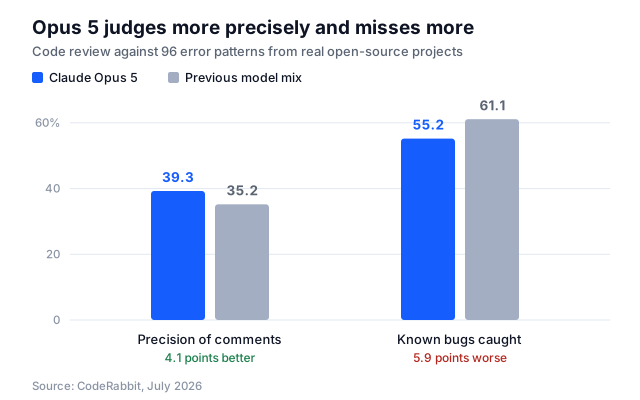
Own illustration, data from CodeRabbit’s model review, July 2026. Measured against 96 error patterns from real open-source projects, three runs per configuration.
The highest precision they have ever measured, and still it catches fewer of the known bugs than the mix before it. Their verdict: a precision specialist that needs a broader second model alongside it.
What this means for you
CodeRabbit credits Opus 5 with the highest precision it has ever measured, and still concludes that it needs a second, broader model alongside it.
A model that never gives up also answers the question where it guessed. From the outside both answers look identical, equally fluent and equally confident. The difference only becomes visible when the answer states what it rests on.
That is where RelationFlow comes in: answers come out of your company’s own knowledge and name their source. Why one model is never enough covers the rest at greater length.
Sources: Anthropic on Claude Opus 5, the migration guide and effort docs. Independently measured: Artificial Analysis, Epoch AI (via the-decoder) and CodeRabbit. Benchmark context from Vellum. Anthropic publishes its own benchmarks as chart images only, so those percentages have been read off a graph.