Model of the Week
Qwen3.8-Max coded on its own for 24 days
Alibaba's model built a terminal tool by itself, 828 commits against 13 from a human. The weights have been open since 8 August.
 Thomas Reigl Updated 5 min read
On 13 July somebody at Alibaba created an empty repository, gave Qwen3.8-Max a GitHub account of its own and then watched.
Twenty-four days later it holds oh-my-cli, a tool that edits files and runs commands in the terminal by itself, with approval levels for dangerous commands and an Electron application. On 7 August there were 683 commits, 670 from the bot account and 13 from a human.
This model holds on to a task for weeks without anyone steering it. And since 8 August you can download it. That is the real news of this issue, because with the smaller Qwen models publishing has been the rule for years, and with a Max model it never was.
The numbers
| Benchmark | What it measures | Qwen3.8-Max | Comparison |
|---|---|---|---|
| Terminal-Bench 2.1 | multi-step work in the terminal | 86.6 | GPT-5.6 Sol Max: 88.8, Claude Fable 5: 84.6 |
| SWE-bench Pro | fixing bugs in unfamiliar code that has grown over years | 67.7 | Claude Fable 5: 80.0 |
| Price per million tokens | what running it costs | $2 in, $6 out | cache hit: $0.25 |
All three come from Alibaba’s own table, and no independent evaluator has re-measured any of them so far. The only thing left to count for myself was the repository, and there Alibaba’s figure was already out of date.
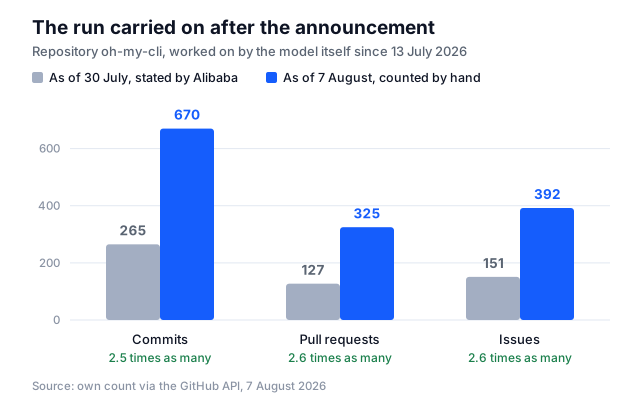
My own count via the GitHub API on 7 August 2026, against Alibaba’s figure for 30 July.
In the week after the announcement, more happened than in the sixteen days before it. After that the run carried on for another week and has been standing still since 12 August. On 13 August there are 841 commits, 828 from the bot and still exactly 13 from a human, along with 403 pull requests and 473 issues. Those thirteen have not grown in a month.
The weights are open
Five days after the announcement, Alibaba followed up. Since 8 August the weights have been on Hugging Face, as Qwen3.8-2.4T-A95B and as an FP8 version. Two days later the first quantisation from the community appeared.
Two caveats belong with that. The open model is not quite what runs behind the API: Alibaba calls Qwen3.8-Max the official version on the same foundation, with image input, a million tokens of context and built-in tools. And the licence is not Apache 2.0 but one of Alibaba’s own. Using, modifying, selling and hosting are all permitted, and above 100 million monthly users you have to name the model in your interface.
The smaller 27B variant Alibaba announced alongside it is still missing. Officially, the only 27B from Qwen on Hugging Face to this day is the one from the previous generation.
The catch
On SWE-bench Pro, Qwen3.8-Max reaches 67.7 and Claude Fable 5 reaches 80.0. That benchmark measures whether a model fixes bugs in unfamiliar code that has grown over years.
oh-my-cli started from nothing, and there the model knows every decision because it made them all itself. In somebody else’s code it has to reconstruct intentions nobody wrote down.
What this means for you
Three ingredients transfer, and none of them is the model: a task with a clear stopping criterion, a check that runs without a human, and a few rules the agent is not allowed to change itself.
In oh-my-cli those sit in AUTONOMY.md, a contract in four parts:
vision, users, product scope and ten non-negotiable safety limits. The file protects itself: the bot may read it and open a change proposal as an issue, but committing or merging it is never allowed. And only an issue it set itself counts as an assignment, while anything arriving from outside is explicitly a hint, never an order.
So the interesting part is the setup, not the model card. And that is exactly what can be rebuilt, with a smaller model too.
Worth testing all the same if you have a recurring task that can be checked automatically. For software that has grown over years, not yet.
In RelationFlow you wire it in under Bring Your Own Model as an OpenAI-compatible endpoint, where a base URL and a model ID are enough.
GDPR: The API sits in China, for which there is no adequacy decision. Personal data belongs there only after standard contractual clauses and a transfer impact assessment.
Locally it stays hard even now that the weights are out: by the rule of thumb in our catalogue, 2.4 trillion parameters come to around 1,300 gigabytes. That is not a workstation, that is a server rack. The announced 27B variant would land at roughly 15 gigabytes, so on a single card, and that is exactly the one that did not arrive.
Sources: qwen-code-dev-bot/oh-my-cli together with its AUTONOMY.md, my own count via the GitHub API on 7 and 13 August 2026, weights and licence per the model card on Hugging Face. Benchmarks and prices per Alibaba’s announcement of 3 August, summarised at MarkTechPost and Developer Tech.